Zuma led the ANC to victory in the 2009 general election and was elected President of South Africa. He was re-elected as ANC leader at the
ANC conference in Mangaung on 18 December 2012, defeating challenger
Kgalema Motlanthe by a large majority,
[12] and remained president of South Africa after the
2014 general election, although his party suffered a decline in support, partly due to growing dissatisfaction with Zuma as president.
Zuma faced significant legal challenges before and during his presidency. He was
charged with rape in 2005, but was acquitted. He has fought a long legal battle over allegations of
racketeering and
corruption, resulting from his financial advisor Schabir Shaik's conviction for corruption and
fraud. On 6 April 2009, the
National Prosecuting Authority dropped the charges against Zuma, citing political interference, although the decision was successfully challenged by opposition parties, and as of February 2018 the charges were before the NPA for reconsideration. After extensive state-funded upgrades to his rural homestead at
Nkandla, the
Public Protectorfound that Zuma had benefited improperly from the expenditure, and the
Constitutional Court unanimously held in 2016's
Economic Freedom Fighters v Speaker of the National Assembly that Zuma had failed to uphold the country's constitution, resulting in calls for his resignation and a failed impeachment attempt in the
National Assembly. Zuma's rule is estimated to have cost the South African Economy R1 Trillion (approximately US$83 Billion).
[13] He has also been implicated in reports of
state capture through his friendship with the influential
Gupta family. He survived multiple motions of no confidence, both in
parliament and within the ANC.
On 18 December 2017,
Cyril Ramaphosa was elected to succeed Zuma as President of the ANC at the
ANC Conference at Nasrec, Johannesburg.
[14] Subsequent months saw growing pressure on Zuma to resign as President of South Africa, culminating in the ANC "recalling" him as President of South Africa. Facing a motion of no confidence in parliament, Zuma announced his resignation on 14 February 2018,
[15] and was succeeded by Ramaphosa the next day.
Early life and political career
Imprisonment and exile
Zuma began engaging in politics at an early age, and joined the
African National Congress in 1959. He became an active member of
Umkhonto we Sizwe in 1962, following the South African government's banning of the ANC the previous year.
[23]
That year, he was arrested with a group of 45 recruits near
Zeerust in the western
Transvaal, currently part of the
North West Province.
[24] Convicted of conspiring to overthrow the apartheid government, a government led by the white minority, Zuma was sentenced to ten years imprisonment, which he served on
Robben Island with
Nelson Mandela and other notable ANC leaders also imprisoned during this time.
[24] Whilst imprisoned, Zuma served as a
referee for prisoners' association football games, organised by the prisoners' own governing body,
Makana F.A.[25]
After his release from prison, Zuma was instrumental in the re-establishment of ANC underground structures in the
Natal province. During this time Zuma joined the African National Congress' Department of Intelligence where he later became the departments Head of Intelligence.
[9]
Zuma first left South Africa in 1975 and met
Thabo Mbeki in Swaziland, and proceeded to
Mozambique, where he dealt with the arrival of thousands of exiles in the wake of the
Soweto uprising. He became a member of the ANC National Executive Committee in 1977.
[24] He also served as Deputy Chief Representative of the ANC in Mozambique, a post he occupied until the signing of the
Nkomati Accord between the Mozambican and South African governments in 1984. After signing the Accord, he was appointed as Chief Representative of the ANC.
[24]
He served on the ANC's political and military council when it was formed in the mid-1980s, and was elected to the politburo of the SACP in April 1989.
[26]
In December 1986, the South African government requested Mozambican authorities expel six senior members of the ANC, including Zuma. As a result of the pressure applied by the apartheid government on Mozambique, he was forced to leave Mozambique in January 1987. He moved to the ANC Head Office in
Lusaka, Zambia, where he was appointed Head of Underground Structures and shortly thereafter Chief of the Intelligence Department.
[24]
Return from exile
Following the end of the ban on the ANC in February 1990, Zuma was one of the first ANC leaders to return to South Africa to begin the process of negotiations.
[9]
In 1990, he was elected Chairperson of the ANC for the Southern Natal region, and took a leading role in fighting political violence in the region between members of the ANC and the
Inkatha Freedom Party (IFP). He was elected the Deputy Secretary General of the ANC the next year, and in January 1994, he was nominated as the ANC candidate for the Premiership of
KwaZulu Natal.
[24]
The IFP, led by
Mangosuthu Buthelezi, put particular emphasis on
Zulu pride and political power during this period. In this context, Zuma's Zulu heritage made his role especially important in the ANC's efforts to end the violence, to emphasise the political (rather than ethnic) roots of the violence, and to win the support of Zulu people in the region.
[28]
MEC of Economic Affairs and Tourism
Deputy presidency
After the
1994 general election, with the ANC becoming a governing party but having lost KwaZulu-Natal province to the IFP, he was appointed as Member of the Executive Committee (MEC) of Economic Affairs and Tourism for the KwaZulu-Natal provincial government.
[30]
In December 1994, he was elected National Chairperson of the ANC and chairperson of the ANC in KwaZulu-Natal, and was re-elected to the latter position in 1996. He was elected Deputy President of the ANC at the National Conference held at
Mafikeng in December 1997 and subsequently appointed executive Deputy President of South Africa in June 1999.
[24]
During this time, he also worked in
Kampala, Uganda, as facilitator of the
Burundi peace process, along with
Ugandan President Yoweri Museveni. Museveni chairs the Great Lakes Regional Initiative, a grouping of regional presidents overseeing the peace process in Burundi, where several armed
Hutu groups took up arms in 1993 against a government and army dominated by the
Tutsi minority that they claimed had assassinated the first president elected from the Hutu majority.
[31]
Criminal charges
Corruption charges
Zuma became embroiled in a corruption controversy, one of many, after his financial advisor,
Schabir Shaik, was charged with corruption and
fraud.
Bulelani Ngcuka, the national director of Public Prosecutions at the time, investigated both Zuma and the Chief Whip of the ANC,
Tony Yengeni, after allegations of abuse of power were levelled against them. This concerned improper influence in the controversial arms deal, and the question of financial benefit as a result of such influence. While Yengeni was found guilty, the case was dropped against Zuma, with Ngcuka stating, "...that there was
prima facie evidence of corruption, but insufficient to win the case in court."
[32]
In 2004, Zuma became a key figure mentioned in the
Schabir Shaik trial. Schabir Shaik, a
Durban businessman and his financial advisor, was questioned over bribery in the course of the purchase of
Valour class frigates for the
South African Navy, a proposed waterfront development in Durban, and lavish spending on Zuma's residence in Nkandla. In the trial Shaik was shown to have solicited a bribe of R500 000 per annum for Zuma in return for Zuma's support for the defence contractor Thomson CSF, documented in the infamous "encrypted fax".
[33][34] On 2 June 2005, Shaik was found guilty and sentenced to 15 years in prison.
[35]
Judge
Hilary Squires elaborates in detail on the numerous transactions that transpired between Zuma and Shaik, summarising with "all the accused companies were used at one time or another to pay sums of money to Jacob Zuma". The media mis-quoted Squires with the phrase "A generally corrupt relationship" (existed between Zuma and Shaik), whereas these exact words do not appear in the court transcripts.
[36] To the defence of the originators of this phrase, the full transcript
[37] of the judgment against Shaik actually does mention Zuma 471 times, uses word "corrupt" or "corruption" 54 times, and contains 12 sentences with both the word "corrupt" and the name "Zuma". Media sources later switched to the phrase "mutually beneficial symbiosis", from the judgment's paragraph 235: "It would be flying in the face of commonsense and ordinary human nature to think that he did not realise the advantages to him of continuing to enjoy Zuma's goodwill to an even greater extent than before 1997; and even if nothing was ever said between them to establish the mutually beneficial symbiosis that the evidence shows existed, the circumstances of the commencement and the sustained continuation thereafter of these payments, can only have generated a sense of obligation in the recipient."
[37]
After twelve days of intense media speculation about his future,
President Thabo Mbeki relieved Zuma of his duties as deputy president on 14 June 2005. Mbeki told a joint sitting of parliament that "in the interest of the honourable Deputy President, the government, our young democratic system and our country, it would be best to release the honourable Jacob Zuma from his responsibilities as Deputy President of the republic and member of the cabinet." Zuma then resigned as a member of parliament.
[38]
In the aftermath of the Shaik trial, Zuma was formally charged with corruption by the National Prosecuting Authority. The case was struck from the roll of the
Pietermaritzburg High Court, after the prosecution's application for a postponement (petitioned in order to allow the NPA to secure admissible forms of documentation required as evidence) was dismissed. In dismissing the application for postponement, the Court rendered moot the defence's application for a permanent stay of proceedings which would prevent Zuma from being criminally prosecuted.
[39]
Zuma's legal team continued to delay proceedings and in spite of Zuma's claim that he desired the matter to appear in court, succeeded in making critical evidence unavailable to the court resulting in the prosecution making an application for postponement on the set date. As the prosecution was not ready the case was struck from the roll after the prosecution's application for a postponement was dismissed,
[39] however Zuma's legal team was unsuccessful in its attempts to have the courts grant a permanent stay of proceedings (which would have rendered Zuma immune to prosecution on the charges). This left Zuma open to being recharged with corruption as soon as the NPA completed preparing its case.
[40]
On 8 November 2007, the Supreme Court of Appeal ruled in favour of the National Prosecuting Authority with respect to appeals relating to various search and seizure exercises performed by them, and rejected four appeals made by Zuma's defence team. This ruling pertained to the National Prosecuting Authority obtaining the personal diary of senior member of a French arms company, which may have provided information relating to Zuma's possible corrupt practices during the awarding of an arms deal.
[41]
On 28 December 2007, the
Scorpions served Zuma an indictment to stand trial in the High Court on various counts of racketeering, money laundering, corruption and fraud. A conviction and sentence to a term of imprisonment of more than one year would have rendered Zuma ineligible for election to the South African Parliament, and consequently he would not have been eligible to serve as President of South Africa.
[42]
Charges declared unlawful
Zuma appeared in court on 4 August 2008. On 12 September 2008, Pietermaritzburg Judge
Chris Nicholson held that Zuma's corruption charges were unlawful on procedural grounds in that the National Directorate of Public Prosecutions ("NDPP") did not give Zuma a chance to make representations before deciding to charge him (a requirement of the
South Africa Constitution), and directed the state to pay legal costs.
[43][44][45] Nicholson also added, however that he believed political interference played a significant role in the decision to recharge Zuma, although he did not say this was the reason why he held that the charges brought against Zuma were unlawful, though it was implied. Nicholson also stressed that his ruling did not relate to Zuma's guilt or innocence, but was merely on a procedural point. Various media reports had incorrectly reported that the charges against Zuma had been dismissed.
[43][46] This was not the case. It remained competent for the NDPP to recharge Zuma, however, only once he had been given an opportunity to make representations to the NDPP in respect of the NDPP's decision to do so. In paragraph 47 of the Judgment, Judge Nicholson wrote:
The obligation to hear representations forms part of the
audi alteram partem principle. What is required is that a person who may be adversely affected by a decision be given an opportunity to make representations with a view to procuring a favourable result. The affected person should usually be informed of the gist or the substance of the case, which he is to answer.
The Court held that the NDPP's failure to follow the procedure outlined in Section 179(5)(d) of the Constitution rendered the decision by the NDPP to recharge Zuma unlawful. Judge Nicholson found that there were various inferences to be drawn from the timing of the charges levelled against Zuma (such as the fact that he was charged soon after he was elected president of the
ANC) which would warrant a conclusion that there had been a degree of political interference by the Executive arm of government. Judge Nicholson writes in paragraph 210 of his judgement:
The timing of the indictment [of Zuma] by Mr Mpshe on 28 December 2007, after the President suffered a political defeat at
Polokwane was most unfortunate. This factor, together with the suspension of Mr Pikoli, who was supposed to be independent and immune from executive interference, persuade me that the most plausible inference is that the baleful political influence was continuing.
In paragraph 220 of the Judgement Judge Nicholson went on to write:
There is a distressing pattern in the behaviour which I have set out above indicative of political interference, pressure or influence. It commences with the "political leadership" given by Minister Maduna to Mr Ngcuka, when he declined to prosecute the applicant, to his communications and meetings with Thint representatives and the other matters to which I have alluded. Given the rules of evidence the court is forced to accept the inference which is the least favourable to the party's cause who had peculiar knowledge of the true facts. It is certainly more egregious than the "hint or suggestion" of political interference referred to in the
Yengeni matter. It is a matter of grave concern that this process has taken place in the new South Africa given the ravages it caused under the
Apartheid order.
[47]
Prior to the hearing there had been a spate of criticism of the South African
Judiciary by Zuma supporters,
[48] amongst whom were some prominent legal minds, such as
Paul Ngobeni.
[49] In that context, the irony was that this was the third time the South African Judiciary had found in his favour, including Zuma's acquittal of the rape charge brought against him. The NDPP soon announced its intention to appeal the decision.
[41]
Charges reinstated on appeal
It was improper for the court to make such far-reaching "vexatious, scandalous and prejudicial" findings concerning me, to be judged and condemned on the basis of the findings in the Zuma matter. The interests of justice, in my respectful submission would demand that the matter be rectified. These adverse findings have led to my being recalled by my political party, the ANC – a request I have acceded to as a committed and loyal member of the ANC for the past 52 years. I fear that if not rectified, I might suffer further prejudice.
[50]
The judgement for the appeal was handed down on 12 January 2009 at the
Supreme Court of Appeal in
Bloemfontein. Deputy Judge President Louis Harms had to rule on two aspects of the appeal. The first aspect was whether or not Zuma had the right to be invited to make representations to the NPA before they decided to reinstate charges of bribery and corruption against him. The second aspect was whether Judge Nicholson was correct in implying political meddling by the then President Thabo Mbeki with regards to the NPA's decision to charge Zuma.
[52]
On the question of the NPA's obligation to invite representations when reviewing decisions, Harms DP found that Nicholson's interpretation of section 179 of the Constitution was incorrect in that the NPA did not have such an obligation and thus was free to have charged Zuma as it did. On the question of Nicholson's inferences of political meddling by Mbeki, Harms DP found that the lower court "overstepped the limits of its authority".
[52]
Charges dropped
On 6 April 2009, the
National Prosecuting Authority (NPA) dropped all charges against Zuma, as well as co-accused French arms company Thint, in light of new revelations about serious flaws in the prosecution.
[53]
The revelations were in the form of intercepted phone calls which Zuma's lawyers claimed showed that the head of the Scorpions, Leonard McCarthy, and the former National Director of Public Prosecutions, Bulelani Ngcuka, had conspired over the timing of the charges laid against Zuma, to the political advantage of Zuma's political rival, President
Thabo Mbeki.
[54]
The announcement of the withdrawal of charges was made by the acting head of the NPA, Mokothedi Mpshe, who however stressed that the withdrawal was due to abuse which left the legal process "tainted", and did not amount to an acquittal.
[55]
Just before the NPA's announcement, however, at least two political parties intimated that they would consider legal action of their own should the charges be dropped.
[56]
The Democratic Alliance subsequently filed for a judicial review of the NPA's decision, with party leader
Helen Zille stating that Mpshe had "not taken a decision based in law, but [instead had] buckled to political pressure".
[57] The case was set to be heard on 9 June 2009.
[58]
While Zuma filed his responses timely, Mpshe delayed the hearing of the matter, requesting two extensions to file the NPA's response. NPA spokesperson Mthunzi Mhaga said he could not file papers because there were "outstanding matters" to be resolved. Zille, the Democratic Alliance's party head contended that Zuma's response was fundamentally wrong and "devoid of any constitutional basis".
[59]
Whilst the legal challenges continued, a survey showed that, as at June 2009, more than half of South Africans believed President Jacob Zuma was doing a good job. The poll, conducted by TNS Research Studies in the last half of June 2009, revealed that Zuma's approval ratings had steadily improved. Around 57% of the people polled said they thought Zuma was a capable leader – this was up 3% from April 2009 when the president was inaugurated. In November 2008, just months after Mbeki was recalled and when Zuma was facing graft charges, only 36% of South Africans were positive about him.
[60]
On Friday, 29 April 2016, the High Court in Pretoria has said the decision taken by former NPA head Mokotedi Mpshe to drop corruption charges against President Jacob Zuma in 2009 was irrational. Judge Aubrey Ledwaba found three contradictions in Mr Mpshe's affidavits explaining his decision to withdraw the charges against President Zuma:
- Mpshe should have followed the legal processes on emergence of the "spy tapes" and allow the courts to decide if the charges should have been withdrawn.
- He acted "alone and impulsively", and therefore his decision was "irrational". The decision from 2009 has been set aside.
- The NPA and its head Shaun Abrahams must now decide if it will recharge President Jacob Zuma with the original 783 counts of corruption.[61]
On Friday 13 October 2017, The Supreme Court of Appeal upheld the 29 April 2016 judgement handed down by the High Court stating that the decision to dismiss the case against Jacob Zuma was not upheld by any jurisprudence.
Judge Eric Leach's ruling was made after an application was brought before the court by Zuma and the NPA to review the original judgement, resulting in them having to pay the costs of the failed application.
[62]
This ruling lays the path for charges to be brought against Zuma, who was given a 30 November deadline to present reasons to the National Prosecutor as to why 783 charges against him should not be reinstated.
[62][63]
Continued support after corruption charges
Zuma's dismissal was interpreted in two ways. Many international observers hailed it as a clear sign that the South African government was dedicated to rooting out corruption within its own ranks. On the other hand, some within South Africa focused on the fact that Zuma and Mbeki represent different constituencies within the African National Congress. Some left-wing supporters claimed that Mbeki and his more market-oriented wing of the party had conspired to oust Zuma to entrench their dominance in the ANC.
[65]
Zuma's cause rallied large crowds of supporters at each of his corruption-related court appearances in 2005. At one court date, Zuma supporters burned T-shirts with Mbeki's picture on them, which earned the condemnation of the ANC; Zuma and his allies urged a return to party discipline for subsequent gatherings. At the next court date in November, Zuma supporters numbering in the thousands gathered to support him; he addressed the Durban crowd in Zulu, urging party unity and singing the apartheid-era struggle song
Lethu Mshini Wami with lyrics that translate literally as "bring me my machine" but understood to refer to a machine gun. At an October tour for the ANC Youth League elsewhere in the country, Zuma also earned the cheers of large crowds. While his political strength was at least partly based on his relationships within intra-party politics, one analyst argued that his supporters' loyalty could be explained as rooted in a Zulu approach to loyalty and mutual aid.
[66]
Because of his support among elements of the party, Zuma remained a powerful political figure, retaining a high position in the ANC even after his dismissal as the country's deputy president. A panel of political analysts convened in November 2005 agreed that if he was to be found innocent of the corruption charges brought against him, it would be hard for any other potential ANC candidate to beat Zuma in the race for the country's presidency in 2009. However, these analysts also questioned whether Zuma was indeed a left-wing candidate of the sort that many of his supporters seem to seek, and noted that the global and national economic constraints that have shaped Mbeki's presidency would be no different in the next presidential term.
[67]
Rape charges
In December 2005, Zuma was charged with raping a 31-year-old woman at his home in
Forest Town, Gauteng. The alleged victim was from a prominent ANC family, the daughter of a deceased struggle comrade of Zuma, and also an
AIDS activist who was known to be
HIV-positive. Zuma denied the charges and claimed that the sex was
consensual.
Even before charges were filed, as rumours about rape accusations surfaced later in November, Zuma's political prospects began to appear to take a turn for the worse. Most of his higher-level political supporters could not respond to these new charges the way they had the corruption charges. In a hearing prior to the rape trial, a group of thousands of his supporters gathered near the courthouse, as a smaller gathering of anti-rape groups demonstrated on behalf of the alleged rape victim.
[68] As he did throughout the trial, Zuma sang
Lethu Mshini Wami (Bring me my
machine gun) with the crowd, and ANC Youth League and Communist Party Youth League spokesmen spoke in support of Zuma.
[69]
As the rape trial proceeded, reports surfaced that the South African Communist Party was severely divided over how to address the issue of Zuma and the SACP's relationship to him. Many members of the party's youth wing supported Zuma while others in the SACP were sceptical about the value of rallying behind a particular person as opposed to emphasizing principles of governance.
[70][71]
Despite the defection of some former supporters, many Zuma supporters continued to rally outside the courthouse, arousing criticism by anti-rape groups for regular attacks on the integrity and moral standing of Zuma's accuser, insults yelled at a close friend of the accuser, and even stones thrown at a woman that members of the crowd mistook for the accuser.
[72] Zuma's defence team introduced evidence relating to the woman's sexual past, and asserted that the sex that took place was consensual. The prosecution asserted that her lack of resistance was due to a state of shock, and that the relationship between the two was like that of a 'father-daughter' pair.
[73][74]
The trial also generated political controversy when Zuma, who at the time headed the National AIDS Council, admitted that he had not used a condom when having sex with the woman who now accuses him of rape, despite knowing that she was HIV-positive. He stated in court that he took a shower afterwards to "cut the risk of contracting HIV". This statement was condemned by the judge, health experts, and AIDS activists. The popular South African comic strip,
Madam & Eve, and well known
political cartoonist,
Zapiro, repeatedly lampooned the matter. HIV educators emphasised that this would do nothing to prevent HIV transmission.
[75]
On 8 May 2006, the court acquitted Zuma of rape, finding that the sexual act in question was
consensual, but also censuring Zuma for having unprotected sex with an HIV woman who was not his partner.
[76]
As his rape trial ended, many South Africans wondered how their political system would recover from the rifts that Zuma's trials have exposed. A
Mail & Guardian analysis saw these events as especially troubling:
The political damage is incalculable, with the ruling African National Congress now an openly divided and faltering movement. This has had a
domino effect on the South African Communist Party and the Congress of South African Trade Unions, which have floundered and fractured in the face of damaging charges against a man they ardently backed as the country's next president.
The trial has been fought against the backdrop of a bitter succession war between Mbeki and Zuma. ... Mbeki's support in the ANC has crumbled, with the party faithful refusing to accept that he will anoint a leader... But even Zuma's most diehard supporters privately acknowledge that he cannot now be president, regardless of the trial outcome.
[77]
Nonetheless, Business Day's Karima Brown told
The Guardian after the rape trial's verdict was handed down:
Jacob Zuma is back. This poses a serious dilemma for the ANC leadership. Now Zuma is marching back into Luthuli House [the ANC party HQ]. He will demand to be reinstated as deputy president and the others will find it difficult to block him … This is a major victory for Zuma's political career.
[78]
The prospect of Zuma's return as a contender for the presidency caused concern for international investors. An Independent analyst suggested, "The fear of seeing Zuma and his crowd marching to the Union Buildings wielding machine guns is unnerving mostly to the middle class and businessmen, according to recent surveys."
[79]
As a backlash to the frenzied media following his rape trial, Zuma filed a series of defamation lawsuits on 30 June 2006 against various South African media outlets for publishing content that allegedly besmirched his public profile, in the form of cartoons, commentary, photos and parody pieces. The media outlets that came under fire were
The Star for R 20 million, Rapport for R 10 million,
Highveld Stereo for R 6 million,
The Citizen for R 5 million,
Sunday Sun for R 5 million,
Sunday Independent for R 5 million, and
Sunday Worldfor R 5 million.
[80]
Zuma appointed Former Conservative Party MP advocate Jurg Prinsloo, as well as Wycliffe Mothuloe to tackle his so-called "crucifixion by the media". Zuma said:
[81]
For a period of five years my person has been subjected to all types of allegations and innuendo, paraded through the media and other corridors of influence without these allegations having being [
sic] tested. I have thereby been denied my constitutional right to reply and defend myself.
2018 corruption charges
On 16 March 2018, it was confirmed by the director of public prosecutions that Zuma would face 18 charges of corruption, including more than 700 counts of fraud and money laundering.
[82] Zuma's political allies within the ANC and Tripartite Alliance protested the prospect of a corruption trail. Some allies such as Julius Malema (then leader of the
African National Congress Youth League) and
Zwelinzima Vavi stated that they would "kill for Zuma" whilst other Zuma allies stated that the trail would threaten South Africa's political stability.
[83] Judge Nicholson set aside the National Prosecuting Authority' case against Zuma stating that he could not rule out political interference in it.
[84]
Rise to the Presidency
On 14 June 2005, President Thabo Mbeki removed Zuma from his post as Deputy President due to allegations of corruption and fraud related to the
$5-billion weapons acquisition deal by the South African government in 1999.
[41] Zuma's successor as Deputy President of South Africa was
Phumzile Mlambo-Ngcuka, the wife of
Bulelani Ngcuka. Mlambo-Ngcuka had been Minister of Minerals and Energy since 1999. While her appointment was widely welcomed by the business community, she was booed publicly at many ANC rallies by Zuma supporters between the time corruption charges had been filed but before rape charges were made, with the first booing taking place in Utrecht.
[85]
Election as ANC president
In terms of party tradition, as the deputy president of the ANC, Zuma was already in line to succeed Mbeki. Mbeki however sought a third term as ANC president, though the South African Constitution would not have allowed him a third term as President of South Africa. The party structures held their nominations conferences in October and November 2007, where Zuma appeared favourite for the post of ANC President, and, by implication, the President of South Africa in 2009.
[86][87][88] With then-incumbent ANC- and South African President Thabo Mbeki as his opposition, Zuma was elected President of the ANC on 18 December 2007 with 2329 votes, beating Mbeki's 1505 votes.
[89]
President of South Africa (2009–2018)
In September 2008, the breakdown in the relationship between the ruling ANC and its presidential appointee, Thabo Mbeki, reached a tipping point, with the ANC NEC's decision to recall Mbeki.
[41] Mbeki elected not to challenge this decision and resigned as President of South Africa. The ANC announced that the party's deputy president,
Kgalema Motlanthe, would become president until
2009 general elections, after which it was intended that Zuma would become president.
[92][93] Zuma declared that he would prefer to only serve one term as president.
[94]
The ANC won the national election on 6 May 2009 and Zuma was sworn in as President of South Africa on 9 May 2009.
[41]
Release of Shaik on parole
In March 2009,
Schabir Shaik was released from prison just 28 months into his fifteen-year sentence. He had been granted medical parole, a leniency meant only for the terminally ill, despite the opinion of his doctors that he was fighting fit and free for hospital discharge. Media speculation had it that Zuma may have played a role in this eventuality, but the ANC President's spokesman firmly denied it. Only days before, however, he had publicly stated that, as President of South Africa, he would personally ensure Shaik's release.
[95]
Ngcobo's nomination as Chief Justice
On 6 August 2009, Zuma nominated
Sandile Ngcobo as
Chief Justice of South Africa,
[96] drawing criticism from four opposition groups.
[97]On 1 October 2009, the appointment was confirmed. The Democratic Alliance, the Congress of the People, the Inkatha Freedom Party and the Independent Democrats accused Zuma of failing to consult properly ahead of his nomination of Ngcobo. The opposition urged Zuma to restart the process from scratch saying they would prefer current Deputy Chief Justice
Dikgang Moseneke for the post.
[98]
Failure to disclose assets
As President of South Africa, Zuma was required to declare his financial interests within 60 days of taking office. But, as of March 2010, he had failed to do so, nine months after taking office. This led to calls for him to do so by opposition parties, and ANC alliance partner COSATU.
[99] ANC spokesman, Brian Sokutu, stated that Zuma constituted a "special case", because of his "large family" making it difficult to declare his assets. The ANC later distanced itself from this statement.
[100] Zuma disclosed his interests shortly after.
[101]
Death of Nelson Mandela
Zuma officially announced the death of Nelson Mandela, South Africa's first democratically elected president, in a press conference on 5 December 2013.
[102][103] Zuma was booed and heckled by the crowd at the memorial service for Nelson Mandela.
[104] Al Jazeera reported that "for many South Africans, Zuma represents some of the nation's least appealing qualities. They consider their deeply flawed president and faltering government and mutter dark thoughts about a failing state and a banana republic."
[105]
Second term
On 18 January 2014, it was reported that Zuma would be the sole candidate for the ANC in the upcoming national election. It was reported that, in spite of speculation to the contrary, because of the controversies surrounding him, the ANC was "united behind Zuma" and would not field another candidate for the presidency in the upcoming national election. ANC Deputy Secretary General Jesse Duarte stated "The policy is that the president of the ANC is always the candidate for the election. We don't have another candidate and there will be no other candidate. Let us be clear."
[106]
On 26 January 2014, it was reported that at least four of the 11 ANC regional leaders in KwaZulu-Natal had confirmed the existence of a "resolution" taken to approach Zuma to ask him not to run for a second term as the country's president. The resolution had reportedly gained momentum in November 2013 when the ANC was preparing for the national list conference, however, it "lost traction" after the death of Nelson Mandela.
[107]
On 21 May 2014, following the
2014 general elections, in which the ANC retained their majority, Zuma was elected for a second term as president by the National Assembly.
[108]
Research group
IPSOS has in part credited Jacob Zuma's presidency for the rise of
populism in South Africa.
[109]
Foreign policy
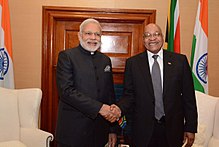
Zuma and Indian Prime Minister
Narendra Modi in South Africa, 8 July 2016
Political-economic orientation
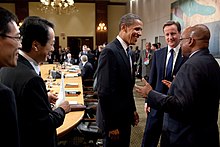
Obama,
Cameron, and Zuma talking at the African Outreach session.
Zuma and Zimbabwe
The African National Congress, of which Zuma was president, historically has considered the
ZANU-PF party a natural ally, born out of mutual struggle against white minority rule. Former South African president Thabo Mbeki had never publicly criticised Mugabe's policies – preferring "quiet diplomacy" rather than "megaphone diplomacy", his term for the harsh Western condemnations of Mugabe's leadership.
[114][115] However, the left of the party and extra-party organisations such as the
ANC Youth League, the
South African Communist Party and the
Congress of South African Trade Unions (COSATU) have advocated for a tougher stance on Zimbabwe.
[116][117] It was from these organisations that Zuma derived his support.
[citation needed]
Zuma's stance on
Zimbabwe was mixed. In a 2006 interview with the German magazine
Der Spiegel, he expressed more sympathetic sentiments towards Mugabe, saying that "Europeans often ignore the fact that Mugabe is very popular among Africans. In their eyes, he has given blacks their country back after centuries of colonialism." He continued: "The people love him, so how can we condemn him? Many in Africa believe that there is a racist aspect to European and American criticism of Mugabe. Millions of blacks died in Angola, the Republic of Congo and Rwanda. A few whites lost their lives in Zimbabwe, unfortunately, and already the West is bent out of shape."
[118]
However, by December 2007, he was more forthright in criticising Zimbabwe's leadership, increasingly defining his own policy in contrast to that of Mbeki:
It is even more tragic that other world leaders who witness repression pretend it is not happening, or is exaggerated. When history eventually deals with the dictators, those who stood by and watched should also bear the consequences. A shameful quality of the modern world is to turn away from injustice and ignore the hardships of others.
[119]
Zuma criticised Mbeki, accusing him of being lenient on
dictators.
[120]
Following the disputed
elections in Zimbabwe on 29 March 2008, he became critical of the election process in Zimbabwe
[121] referring to delays in the outcome as "suspicious".
[122]In a press conference on 24 June, he asserted: "We cannot agree with ZANU-PF. We cannot agree with them on values. We fought for the right of people to vote, we fought for democracy."
[123] At an ANC dinner in July, he rebuked Mugabe for refusing to step down.
[124]
Nkandla homestead and Public Protector findings

Zuma and his fourth wife, Thobeka Madiba-Zuma during a visit of Iranian city of
Isfahan
After Zuma became president, his private homestead at Nkandla in rural KwaZulu-Natal was substantially upgraded by the state. In November 2013 opposition parties accused Zuma of having used taxpayer funds not only for security improvements, but also private additions and improvements to his home.
[125][126] Zuma answered in parliament that he was unaware of the scale of the work, but agreed to two investigations, one to probe its rising costs, and another to determine any breaches of parliamentary spending rules.
[127] The Public Protector's report "Secure in Comfort" found that Zuma and his family had benefited improperly from the upgrades, that a swimming pool (claimed to be a "fire pool"), amphitheatre, cattle kraal and chicken run were not security features, and that Zuma had violated the executive ethics code and had not asked "questions regarding the scale, cost and affordability of the Nkandla project."
[128] After rival reports by the police's Special Investigative Unit and a parliamentary ad hoc committee attempted to exonerate Zuma, opposition parties went to the Constitutional Court to establish whether the Public Protector's report was binding. Shortly before the Constitutional Court hearing in February 2016, Zuma's attorneys recognised that the Public Protector's findings were binding and said that Zuma was ready to pay back part of the cost of the upgrade.
[129] On 31 March 2016, the Constitutional Court delivered a unanimous judgement in
Economic Freedom Fighters v Speaker of the National Assembly and Others stating that the Public Protector's report was binding and that Zuma and the
National Assembly had failed to uphold the country's constitution. The court ordered National Treasury to determine the amount that Zuma must pay back and ordered Zuma to do so within 45 days of the court's approval of the National Treasury report.
[130]
In the immediate wake of the judgment,
Julius Malema and
Mmusi Maimane, the leaders of the two victorious applicants in the case, called for Zuma to step down.
[47][48][49]However, Zuma sought to downplay the judgment. In a press statement the following evening, he said he welcomed the judgment and had always accepted the Public Protector's reports were binding, and noted that the Court found he had been entitled to institute a parallel investigative process and had acted "honestly" and "in good faith".
[50] Legal commentators condemned these claims as serious misrepresentations of the judgment.
[51][52] They pointed out that it could not possibly have been the case, as Zuma claimed, that he was merely adopting the
High Court's approach to the powers of the Public Protector in its
DA v SABC judgment, because that was handed down six weeks
after Zuma signaled his intention not to comply with her report.
[43] Commentators also condemned the Presidency's statement
[53][54] that the Court had never found Zuma breached his office, since that was the judgment's unmistakable implication.
[55][56]
But the ANC continued to support Zuma. The
ANC Women's League had released a statement hours after the judgment saying its faith in Zuma "remains unshaken".
[131][132]Secretary-General
Gwede Mantashe, speaking on behalf of the so-called Top Six, said he "welcomed" Zuma's apologetic statement but that calls for his impeachment were "over-exaggerated".
[133][134] Chief Whip Jackson Mthembu and Deputy Minister of Justice John Jeffery took the view that, although Zuma had breached the Constitution, the breach was not "serious".
[135][136] The impeachment bid by opposition MPs on 5 April 2016 failed by over 120 votes.
[136] Some were surprised that even Zuma's opponents within the ANC like
Cyril Ramaphosa and
Pravin Gordhan had voted against the motion.
[137][138] The
Congress of the People, an opposition party, said it would boycott parliamentary proceedings in light of the National Assembly's failure to implement the Court's judgment.
[139]

Zuma and
Narendra Modi at the India-South Africa business summit in Pretoria, 2016
Nevertheless, many analysts said the judgment might prove a fatal blow to Zuma, although factional battles within the ANC would be the ultimate decider.
[140][141][142] One suggested that powerful ANC members had lost faith in Zuma and might move to oust him at a more opportune moment.
[137] The
South African Communist Party, part of Zuma's own
Tripartite Alliance, had been skeptical about the adequacy of his response to the judgment.
[143] Some ANC members booed Zuma at his next subsequent appearance.
[144] And several prominent members of civil society and former ANC insiders, including
Ahmed Kathrada,
Ronnie Kasrils,
Trevor Manuel,
Cheryl Carolus, and retired Constitutional Court judge
Zak Yacoob, called for Zuma's resignation,
[145][146][147][148] prompting a backlash from certain Zuma allies.
[149]The
South African Council of Churches did the same, saying Zuma had "lost all moral authority".
[150][151] The Gauteng ANC, led by noted Zuma critic
Paul Mashatile, formally resolved that Zuma must resign;
[152][153] doubts were raised about Zuma's leadership even within his traditional strongholds like the ANC's
Limpopo branches;
[154] and an internal ANC memorandum sent by party veterans to the Top Six allegedly demanded Zuma's recall and compared him to detested
apartheid-era
President P. W. Botha.
[151] Finally, members of the
Gupta family, thought to be Zuma's long-standing allies and crucial financial backers, resigned from their major holding company and fled South Africa for
Dubai in the week after the judgment – leaving Zuma, in the opinion of some analysts, extremely vulnerable.
[155][156] In the wake of these developments, Malema said it was now time to "crush the head of the snake".
[157] On 12 April 2016,
Max du Preez said the key question, "now that the balance of power has turned irrevocably against Zuma", was how to ensure he makes a managed – and non-violent – exit.
[158]
Gupta family relationship

A protest placard depicting Atul Gupta carried by two EFF members at a
Zuma Must Fall protest in Cape Town, 2017
Zuma's close and allegedly corrupt relationship with the Gupta family has been a major source of discontent within both his own party
[159] – the ANC – and the South African public.
[160][161][162] The
portmanteau "
Zupta", a combination of "Z" from "Zuma" and the "upta" from "Gupta", was first coined by the
Economic Freedom Fighters at the 2016 South African presidential state of the nation address when they disrupted the event by repeatedly chanting "Zupta must fall" to express their dissatisfaction with this relationship.
[163][164]
South African Opposition parties have made claims of "
State Capture" following allegations that the Guptas, said to be close to President Jacob Zuma, his family and other ANC leaders, had insinuated themselves into a position where they could offer Cabinet positions and influence the running of government.
[165] These allegations were made in light of revelations by Deputy Finance Minister Mcebisi Jonas and former MP Vytjie Mentor that they had been offered Cabinet positions by the Guptas at the family's home in Saxonwold, Johannesburg.
[166]
Dismissal of Nhlanhla Nene
On 9 December 2015, President Jacob Zuma issued a statement replacing Finance Minister
Nhlanhla Nene with the little-known
Des van Rooyen.
[167][168][169] It was widely suspected that Nene was replaced for reasons all related to him vetoing suspect and/or controversial uses of public funds including the vetoing of South African Airways (SAA) chairperson
Dudu Myeni's attempt to purchase 5
Airbus A330s through an unnamed third party, not approving a proposed SAA direct flight route between Sudan and South Africa,
[170] Nene's resistance to approving funding for a nuclear deal with Russia,
[171] not approving the purchase of a new R4 billion
[172] Boeing 787 presidential plane, and the downgrading of South Africa's credit rating to just above '
junk' status by international rating agencies.
[173][174]
Strong links between both of Van Rooyen's top two advisers and the
Gupta family came to light a few months later,
[175][176] prompting concerns that Nene's firing was an attempt at
state capture by political and business associates of the Zuma family.
[177]
The dismissal of Nene caused a public outcry and a strongly negative reaction by
international markets[178] causing the
rand to lose 10% of its value and the withdrawal of an estimated R180 billion from the
Johannesburg Stock Exchange in the two days following the announcement.
[179][180][181][182] In addition to the public and opposition political parties the business community,
COSATU and other trade unions, the
Communist Party of South Africa, as well as many within the ruling ANC called for Zuma to reverse the decision. Four days after the announcement on 13 December a senior ANC delegation met with Zuma and told him to reinstate Nene or appoint former minister of finance
Pravin Gordhan.
[183] A few hours later Zuma announced that van Rooyen would be replaced by the better known and trusted Pravin Gordhan.
[184][185] This event is thought to have increased the rift between Zuma and the rest of the ANC
[186] including Deputy President
Cyril Ramaphosa,
[183] something that Ramaphosa denied.
[187] Ranjeni Munusamy of the
Daily Maverickstated that this has exposed President Zuma as a "
weak leader who acted recklessly without proper advice" indicating that the firing of Nene has greatly damaged Zuma's political standing.
[188]
Dismissal of Pravin Gordhan
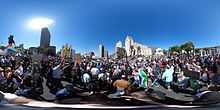
A 360 degree photograph of the Zuma Must Fall protests in front of the South African Parliament buildings in Cape Town. Click
here to see the photo in 360 degrees.
In the early hours of 31 March 2017, the Presidency announced a
major cabinet reshuffle in which Finance Minister Pravin Gordhan and his deputy Mcebisi Jonas were dismissed, with
Malusi Gigaba appointed as the new Finance Minister. The reshuffle affected 10 cabinet ministers, 5 of whom were dismissed, and 10 deputy ministers.
[189] The reshuffle was strongly criticised by Deputy President Cyril Ramaphosa and other senior ANC and SACP leaders,
[190] and led to increased calls for Zuma to resign, including opposition calls for a motion of no confidence and impeachment. The
SACP's Second Deputy General Secretary
Solly Afrika Mapaila indicated that
ANC members of Parliament should themselves raise the prospect of a vote of no confidence in the President.
[191] Shortly after the removal of
Pravin Gordhan, ratings agency
Standard and Poor's downgraded South Africa's sovereign debt to BB+, commonly known as junk status.
[192] Partly in response to the dismissal of the Gordhan marches and protests were held on 7 April 2017 in South Africa's major cities with a total of 60,000 protesters taking part.
[193] The largest of the protests occurred in Cape Town with an estimated 12,000
[193] to 80,000
[194] participants and Pretoria with an estimated 25,000 joining protests at the Union Buildings.
[195]
2017 motion of no confidence
On 7 August 2017, Speaker
Baleka Mbete announced that she would permit a
motion of no confidence in Zuma's government to proceed in the National Assembly via
secret ballot. It was the eighth motion to be brought against Zuma in his presidency and the first to be held via secret ballot. After the vote was held the next day, the motion was defeated 198–177, with 25 abstentions.
[196] Around 20 ANC MPs voted in favor of the measure.
Succession and resignation
From 2015, Jacob Zuma was understood to favour his ex-wife,
Nkosazana Dlamini-Zuma, to succeed him both as President of the African National Congress and as President of South Africa, in order to retain his control of the ANC and the state through her, and to avoid prosecution for still pending criminal charges.
[197][198][199] In December 2017, Dlamini-Zuma was defeated by
Cyril Ramaphosa in the election for the ANC Presidency at the
ANC Conference at Nasrec, Johannesburg.
[200]
Following the end of Zuma's term as ANC President, pressure grew for Zuma to be replaced as President of South Africa. The annual State of the Nation Address scheduled for 8 February was postponed indefinitely 2 days beforehand.
[201] After a week of discussions within ANC structures and between Ramaphosa and Zuma, the ANC announced on 13 February that Zuma had been requested to resign, but had refused, and that the ANC was therefore "recalling" him from the Presidency.
[202] Facing a motion of no confidence in Parliament scheduled for 15 February, Jacob Zuma announced his resignation with immediate effect in a late night address on 14 February.
[15] In July 2018,
City Press reported that elements in the
South African National Defence Force and
State Security Agency had been unsuccessfully lobbied to
launch a revolt to prevent Zuma's removal as President of the country during this period.
[203]
Post-presidency
On the 6th of April 2018, Zuma made his first appearance in the
Durban Magistrates Court for charges of
corruption.
[citation needed]. On 8th June 2018, Zuma appeared before the KwaZulu Natal High Court. His court was postponed to 27th July 2018 after his legal team requested for more time to seek clarity on his legal fees funding.
Controversy
Alleged abuses by bodyguards
In 2010, Zuma's bodyguards were implicated in multiple incidents involving members of the public and journalists.
In February, a Cape Town student,
Chumani Maxwele, was detained by police after allegedly showing Zuma's motorcade a "rude gesture". Maxwele, an active ANC member,
[206]was released after 24 hours, having provided a written apology to police, which he later claimed was coerced. He also claimed that his home had been raided by plain-clothes policemen, and that he had been forced into the vehicle at gunpoint. Maxwele later instituted legal action against the police,
[207] and a complaint was filed on his behalf to the
Human Rights Commission.
[208] The incident led to a heated dispute when it was discussed in Parliament.
[209]
In March, journalist Tshepo Lesole was forced to delete pictures of Zuma's convoy from his camera by police, and two photographers were detained by police when photographing Zuma's Johannesburg home.
[210][citation needed] Sky News reporter Emma Hurd claimed she had been pushed, manhandled and "groped" by Zuma's bodyguards in 2009.
[211]
"Shoot the Boer" song
In January 2012, Zuma gave a speech at the ANC Centennial 2012 celebrations in
Bloemfontein and, afterwards, sang the controversial song "Dubul' ibhunu" ("Shoot the
Boer").
[212][213]
"The Spear" painting
In 2012, Zuma was featured in a
satirical painting by Cape Town-based artist
Brett Murray, who depicted him in his painting
The Spear, in a pose similar to
Lenin, but with his genitals exposed. The ANC responded by threatening court action against the gallery showing the painting, and further demanding that the image should be removed from online sources. The subsequent aggressive sharing of the image through social networks can be considered a form of the
Streisand effect.
[214][215] On 22 May 2012, the painting was vandalised while it was hanging in an art gallery in Johannesburg. The face and genitals of Zuma were painted over.
[216]
Panama Papers revelations
Personal life
Wives
- Gertrude Sizakele Khumalo (MaKhumalo), whom he met in 1959 and married shortly after his release from prison in 1973.[222] They have no children.
- Nkosazana Dlamini-Zuma, a cabinet minister from 1994 to 2012, with whom he has four daughters, Msholozi (born 1982), Gugulethu Zuma-Ncube (born 1985), Thuli (born 1987), and Thuthukile Zuma (born 28 April 1989). They divorced in June 1998.[223]
- Kate Mantsho (born 2 September 1956), from Mozambique, with whom he had five children, Mxolisi (b. 1980, married Phindile Luthuli in Durban in 2008, betrothed to Swazi princess Ziyanda Dlamini [224]), twins Duduzile and Duduzane (b. 1984), Phumzile (b. 1989) and Vusi (born 1993, died 2 July 2018 [225]). She committed suicide on 8 December 2000 and is buried in Heroes' Acre at Westpark Cemetery in Johannesburg.[127][223][226]
- Nompumelelo Ntuli (MaNtuli), married on 8 January 2008. Ntuli, born 1975, is a resident of KwaMaphumulo near Stanger and has three children. The first two are Thandisiwe and Sinqobile.[223]
- Thobeka Stacie Madiba (born Mabhija, her mother's name), married 4 January 2010, with whom he has three children.[227] Zuma paid lobola to her clan in 2007. Their first child was born in October 2007. She has another of Zuma's out-of-wedlock children living with her.[227] Mabhija grew up in Umlazi, where she matriculated at Umlazi Commercial High School. She has worked at Standard Bank, Ithala, Cell C and SA Homeloans in La Lucia.[228][229][230] She owns a house in Durban North.[231] In 2016, the BBC credited her for campaigning for the rights of girls at risk of forced or child-age marriage.[232]
- Gloria Bongekile Ngema, married on 20 April 2012. The wedding took place in Nkandla and was attended by Zuma's three other wives. Following a traditional ceremony known as umgcagco, the bridal party participated in a traditional Zulu competitive celebratory dance. Ngema has one son with Zuma, Sinqumo.[3]
In June 2012, activists, including some from the ANC itself, complained about the amount the state paid to support Zuma's wives, especially in the context of the country's widespread poverty.
[4][127] In 2009–10 Zuma received a budget of £1.2m for "spousal support", almost twice the amount paid during the terms in office of
Thabo Mbeki and
Kgalema Motlanthe, leading to suggestions that only Zuma's first wife should receive state support.
[4]
Fiancées
Other children
- He has another son, Edward, born 1977, with Minah Shongwe, sister of Judge Jeremiah Shongwe, who asked to be recused from Zuma's rape trial because of the liaison.[234]
- He has two daughters, born 18 January 1998 and 19 September 2002, with Pietermaritzburg businesswoman Priscilla Nonkwaleko Mhlongo.[235] In March 2017 Mhlongo was named as one of the speakers in a covert recording in which she was alleged to have outlined a plan for illegally defrauding the province of kwaZulu-Natal of a proportion of its school meals budget, apparently with Zuma's knowledge.[236]
- There are reports of four other children – three from a woman from Johannesburg and one from a woman from Richard's Bay.[227]
- Zuma had a child with 24 year old Nonkanyiso Conco, born on Zuma's birthday, April 12 2018.[237] They plan to marry, with lobola negotiations under way.
2009 "love-child"
In January 2010,
The Sunday Times reported that Sonono Khoza, the daughter of
Irvin Khoza, gave birth to Zuma's 20th child on 8 October 2009, a daughter called Thandekile Matina Zuma.
[238][239] Zuma confirmed that he had paid
inhlawulo, acknowledging paternity. He protested the publishing of the child's name, saying it was illegal exploitation of the child. He denied that the incident had relevance to the government's AIDS programme (which promotes marital fidelity as a mechanism for preventing the disease), and appealed for privacy.
[240] On 6 February, Zuma said he "deeply regretted the pain that he caused to his family, the ANC, the alliance and South Africans in general."
[241] The office of the presidency's comment was that it was a private matter,
[242] and the ANC defended Zuma, saying it saw no links between its policies on HIV/AIDS and Mr Zuma's personal life.
[243]ANC Youth League leader
Julius Malema said "We are Africans and sitting here all of us, Zuma is our father so we are not qualified to talk about that". Malema said the ANCYL would emphasise its HIV programme and "one boyfriend, one girlfriend" stance in an awareness campaign across the country.
[244] ANC Women's League deputy president Nosipho Dorothy Ntwanambi said: "it is not right to have an extramarital affair if you have committed to yourself to a marriage. But under the Customary Marriages Act, if the first wife agrees, and if all these issues are discussed with her, we can't do anything."
[245] On 5 February, the ANC acknowledged the widespread disapproval by saying that the experience had "taught us many valuable lessons", and they had listened to the people.
[246] COSATU, an ANC alliance partner, passed no judgment but hoped that it will be "a matter on Zuma's conscience"
[246] Vavi reiterated Zuma's appeal then that he be accorded his "right to privacy" and the child protected from undue publicity.
Jacob Zuma Foundation


.jpg)


